
MEMORY VERSE: “And the younger of them said to his father, Father, give me the portion of goods that falleth to me. And he divided unto them his living.” Luke 15:12.
BIBLE PASSAGE: 1 Samuel 2:22-25, 29.
INTRODUCTION
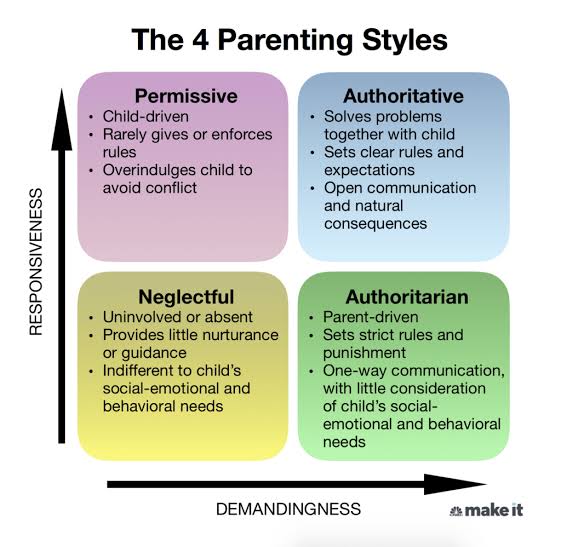
A parent is a person who is responsible for the care, upbringing, and wellbeing of a child. He/she can be biological, legal, or custodian. Some parents are firm, while others are indulgent. Some are attentive, while others are absent- minded. As a Christian parent, raising your children to please God and thrive in life is a big responsibility. Understanding various parenting styles through the degrees of “responsiveness” (the extent to which parents are warm and sensitive to their children) and “demandingness” (the extent of control parents put on their children) is crucial.
OUTLINES
- PERMISSIVE AND UNINVOLVED
- AUTHORITARIAN AND AUTHORITATIVE
“Responsiveness”
PERMISSIVE _AUTHORITATIVE_ NEGLECTFUL_ AUTHORITARIAN
“Demandingness”
PERMISSIVE AND UNINVOLVED
The Permissive Parents are high in “responsiveness/love” but low in “demandingness/discipline”. They communicate openly and usually let their children decide for themselves, rather than giving direction 1 Samuel 2:22-24. Rules and expectations are either not set or rarely enforced 1 Samuel 3:13. They give in to their children’s demand to keep their children happy and avoid conflicts, even at their own expense Luke 15:12. These types of parents hardly rebuke or offer guidance to their children Proverbs 23:13-14. The development of delinquent behaviours and inability to make right decisions by some children are traits common under permissive parenting. However, it has the potential to unduly increase self-esteem and creativity in children negatively.
The Neglectful/Uninvolved Parents are low in “responsiveness/love” and low in “demandingness/discipline.” They usually let their children fend for themselves, perhaps because they are indifferent to their needs. They offer zero guidance, correction, and attention 1 Kings 1:5-6. They find it difficult to form close relationships because of past personal experience that has caused stress in parental relationship, etc. 1 Samuel 16:11-12; 2 Samuel 14:28. They can also be seen as cold and uncaring — but not always intentionally, as they are often struggling with their own issues. Children from parents who neglect them tend to be very self-dependent while also exhibiting some traits of truancy, emotional withdrawal, difficulty in social interaction, and fear of becoming dependent on others Proverbs 29:15.
AUTHORITARIAN AND AUTHORITATIVE
The Authoritarian Parents are high in “demandingness/discipline” but low in “responsiveness/love”. They enforce strict rules with little consideration of their children’s feelings or socio-emotional needs. To be in full control, authoritarian parents often talk to their children without wanting input or feedback. This rigid parenting style uses harsh discipline, it is often justified as “tough love” 1 Samuel 20:30. Low self-esteem, depression, aggression, poor social skills are common in children with authoritarian parents even though they may show signs of discipline and respect for authority.
The Authoritarian Parents are high in “responsiveness/love” and high in “demandingness/discipline”. They set clear rules and expectations for their children while practicing flexibility and understanding. They communicate frequently; they listen to and take into consideration their children’s thoughts, feelings and opinions Genesis 22:7-8. They allow natural consequences to occur, especially for wrong doings but use those opportunities to help their children reflect and learn. Authoritative parents are nurturing, supportive and often in tune with their children’s needs Ephesians 6:4. They guide their children through open and honest discussions to teach values and reasoning Proverbs 22:6. Children who have authoritative parents tend to be self-disciplined, socially competent and can think for themselves (e.g. Mordecai and Esther, Naomi and Ruth). While they are not totally immune to pressures around them, their chances of displaying negative traits common in children trained by authoritarian, permissive or uninvolved parents, is usually very low.
CONCLUSION
Understand that your parenting style will greatly affect your children’s lives.
FURTHER READING
Sun: Proverbs 22:6.
Mon: Genesis 22:7-8.
Tues: Ephesians 6:4.
Wed: 1 Samuel 20:30.
Thurs: 1 Samuel 16:10-11.
Fri: 1 Kings 1:5-6.
Sat: Proverbs 23:13-14.